How Bulk Materials Are Transported
Bulk materials are transported every day across mining, agriculture, construction, recycling, manufacturing, energy, and logistics industries. Unlike packaged goods, bulk materials such as grain, coal, aggregates, minerals, biomass, cement, sand, scrap, and other loose materials are handled without individual packaging.
Moving these materials efficiently requires more than simply choosing a truck or conveyor. The transportation method must match the material characteristics, required capacity, transportation distance, loading and unloading conditions, and available infrastructure.
From conveyors and trucks to containers and specialized handling equipment, there are several common ways to transport bulk materials.
What Is Bulk Material Transportation?
Bulk material transportation refers to the movement of large quantities of loose or unpackaged materials between different points in a production, storage, or logistics process.
A typical bulk material flow may include several stages:
Receiving → Loading → Transportation → Unloading → Conveying → Storage or Processing
Different equipment is used at each stage. For example, a conveyor may transfer material within a facility, while trucks or containers transport material between locations.
The most efficient system is usually one that minimizes unnecessary handling between these stages.
1. Transportation by Conveyor Systems
Conveyors are one of the most widely used methods for moving bulk materials over relatively fixed routes.
A belt conveyor continuously transports material from one point to another. Depending on the application, conveyors can be installed horizontally, inclined, or integrated with loading and unloading equipment.
They are commonly used for:
- Minerals and aggregates
- Coal and other energy materials
- Grain and agricultural products
- Biomass
- Cement and construction materials
- Recycled materials
- Industrial raw materials
The main advantage of conveyor transportation is continuous material flow. Once the system is running, material can be transferred at a relatively consistent rate without requiring individual vehicle movements.
For applications where permanent conveyors are not practical, mobile conveyor systems can provide additional flexibility. A self-feeding truck loading mobile conveyor, for example, can collect material directly from the ground or stockpile and convey it into a truck, reducing the need for a separate loading machine.
2. Transportation by Trucks
Trucks remain one of the most flexible methods of bulk material transportation, particularly when material needs to be moved between locations that are not connected by fixed conveyors.
Bulk materials can be transported using dump trucks, tipper trucks, bulk trailers, and other specialized vehicles.
Truck transportation is widely used in:
- Mining operations
- Construction projects
- Aggregate production
- Recycling facilities
- Agricultural logistics
- Industrial material distribution
The flexibility of trucks allows materials to be transported over different distances and routes. However, the overall efficiency of truck-based transportation depends heavily on loading and unloading speed.
A truck that spends a significant amount of time waiting to be loaded or unloaded reduces the utilization of both the vehicle and the material handling system.
This is why truck loading and unloading equipment should be considered together with transportation capacity.
3. Loading Bulk Materials onto Trucks
The loading process determines how quickly a truck can begin its transportation cycle.
Traditional truck loading may use wheel loaders, excavators, hoppers, or fixed loading systems. These approaches can be effective, but the right method depends on the material and site layout.
For operations where material is stored in a stockpile or on the ground, a self-feeding truck loading mobile conveyor can provide an alternative approach.
The equipment can collect bulk material through its feeding mechanism and transfer it onto a conveyor. The conveyor then delivers the material directly into the truck.
This type of system can reduce the number of machines involved in the loading process while providing a mobile solution that can be repositioned according to site requirements.
4. Unloading Bulk Materials from Trucks
Transporting bulk material is only part of the process. Once a truck reaches its destination, the material must be discharged efficiently.
Dump trucks can raise their bodies to discharge material, but standard flatbed trucks and other vehicles may require additional unloading equipment.
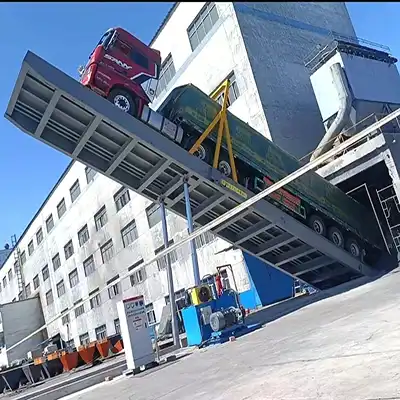
A truck dumping platform can be used to raise and tilt a truck or trailer, allowing bulk material to flow out under gravity.
Hydraulic lifting systems provide controlled movement and can be designed for different truck sizes and material types.
For high-volume operations, faster unloading can significantly reduce truck turnaround time. This can increase the number of transportation cycles that a fleet can complete during a working day.
5. Transportation in Containers
Containers provide another important method of transporting bulk materials, particularly when the material needs to travel long distances through multimodal logistics networks.
A container can be transported by truck, rail, or ship without transferring the material itself between transportation modes.
This can be especially useful for international supply chains.
However, transporting bulk materials in standard containers creates specific loading and unloading challenges. Unlike packaged cargo, loose material needs to be distributed efficiently inside the container to make good use of its internal volume.
Depending on the material and loading method, companies may use horizontal loading systems, telescopic conveyors, or vertical container loading solutions.
6. Vertical Container Loading and Unloading
One approach to container bulk handling is to change the orientation of the container during the loading or unloading process.
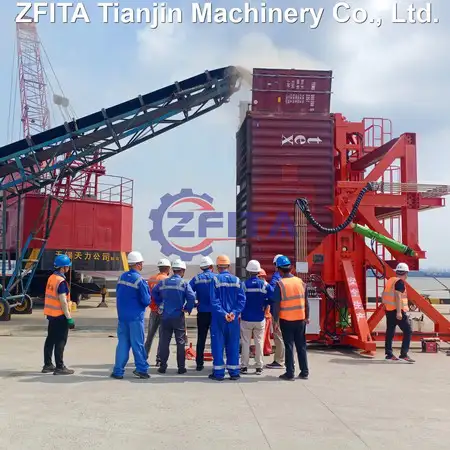
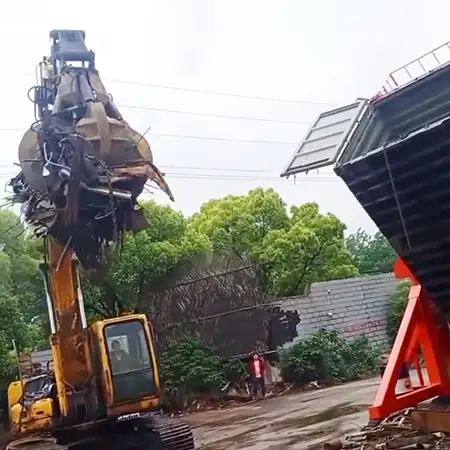
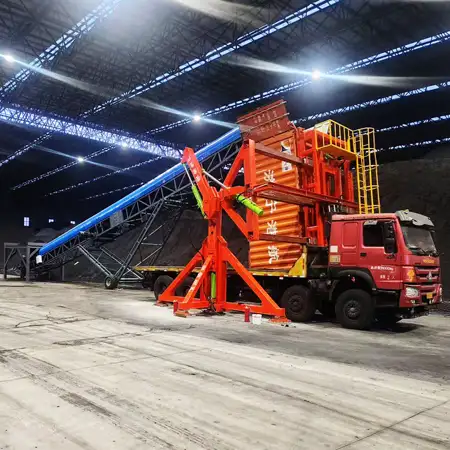
A container tilter is designed to securely hold a container and rotate or tilt it to a controlled position.
During vertical loading, the container can be positioned so that bulk material can be loaded more directly under gravity. During unloading, tilting the container can help material flow toward the discharge opening.
This can be useful for materials that are difficult to remove from a horizontally positioned container.
Container tilters are commonly considered for applications involving minerals, agricultural commodities, biomass, scrap, and other bulk materials.
The appropriate configuration depends on container size, material characteristics, required throughput, and the operating environment.
7. Rail Transportation for Bulk Materials
Rail is particularly effective for transporting large quantities of bulk material over long distances.
Mining companies, power plants, grain terminals, and industrial facilities may use rail systems to move thousands of tons of material between production areas, storage facilities, and processing plants.
Typical bulk materials transported by rail include:
- Coal
- Iron ore
- Grain
- Cement
- Aggregates
- Minerals
- Industrial raw materials
The main advantage of rail transportation is its high carrying capacity. However, rail systems require dedicated infrastructure, loading facilities, unloading stations, and coordination with other transportation methods.
For this reason, rail transportation is often part of a larger multimodal bulk material handling system.
8. Maritime Transportation
Ships are essential for transporting bulk materials across international markets.
Bulk carriers can transport very large quantities of materials such as iron ore, coal, grain, cement, fertilizer, and other commodities.
At ports, material must be transferred between ships and land-based transportation systems. This requires specialized equipment such as ship unloaders, conveyors, hoppers, feeders, and stockpiling systems.
Port operations place particular emphasis on throughput because delays during loading or unloading can affect the entire transportation chain.
9. Multimodal Bulk Material Transportation
In many modern supply chains, bulk materials are transported using more than one transportation method.
For example:
Mine → Truck → Rail → Port → Ship → Customer
Or:
Production Plant → Conveyor → Truck → Distribution Center → Container → Ship
This is known as multimodal transportation.
The challenge is not simply choosing the right truck, ship, rail system, or container. The transfer points between different transportation modes are equally important.
Efficient bulk material handling equipment helps connect these transportation stages and reduce delays during transfer.
For example, truck scales can provide accurate vehicle weight information before transportation, conveyors can transfer material between storage and loading areas, and container handling equipment can facilitate the movement of bulk materials into or out of shipping containers.
10. Weighing Bulk Materials During Transportation
Weight measurement is an important part of bulk material transportation.
For truck-based transportation, truck scales or truck weighbridges can determine the gross weight of a loaded vehicle and the tare weight of an empty vehicle. The difference can be used to calculate the actual material weight.
Accurate weighing is important for:
- Load management
- Inventory control
- Transportation billing
- Production records
- Customer transactions
- Compliance with weight limits
Integrating weighing into the transportation process can also help companies monitor material movement more accurately.
Choosing the Right Transportation Method
There is no universal transportation method for every bulk material application.
The best solution depends on several factors:
Material Characteristics
Particle size, bulk density, moisture, abrasiveness, temperature, and flowability can all influence transportation equipment selection.
Transportation Distance
Short-distance movement within a facility may favor conveyors, while longer distances may require trucks, rail, ships, or a combination of transportation methods.
Required Capacity
A system handling several hundred tons per day may require a very different solution from a mining or port operation handling thousands of tons per hour.
Site Conditions
Available space, terrain, access roads, building limitations, and existing infrastructure can determine which equipment is practical.
Loading and Unloading Requirements
Transportation efficiency is strongly influenced by how quickly material can be loaded and discharged. A high-capacity truck or ship cannot operate efficiently if the loading or unloading process becomes a bottleneck.
From Transportation to Complete Bulk Material Handling
Bulk material transportation should not be considered as an isolated operation. It is one part of a larger material flow that includes receiving, loading, conveying, weighing, transportation, unloading, and storage.
For example, a truck-based system may combine a truck scale for weighing, a self-feeding mobile conveyor for loading, and a truck dumping platform for unloading.
A container-based operation may combine conveyors or feeders for loading with a container tilter for controlled container loading or unloading.
The goal is to create a connected process in which each stage supports the next one.
Improving Bulk Material Transportation Efficiency
Efficient bulk material transportation is ultimately about reducing unnecessary handling, minimizing waiting time, and maintaining a consistent material flow.
The right combination of transportation vehicles and bulk material handling equipment can help companies:
- Reduce loading and unloading time
- Improve equipment utilization
- Reduce unnecessary material transfers
- Lower labor requirements
- Improve weighing accuracy
- Increase transportation capacity
- Adapt equipment to site limitations
Whether the material is moved by conveyor, truck, container, rail, or ship, the most effective system is one designed around the complete material flow.
By analyzing where the material starts, where it needs to go, how much needs to be moved, and how each transfer takes place, companies can build a bulk material transportation system that is faster, more flexible, and more cost-effective.