Common Bulk Material Handling Challenges
Bulk materials such as grain, minerals, aggregates, biomass, scrap, cement, and other loose materials are widely handled across mining, recycling, agriculture, manufacturing, logistics, and port operations. Although the materials and applications may vary, many companies face similar challenges when moving, loading, unloading, weighing, and transferring bulk materials.
An efficient bulk material handling system is not simply about moving material from one point to another. It must also address loading efficiency, equipment utilization, labor requirements, dust control, weighing accuracy, site limitations, and overall operating costs.
Understanding these common challenges is the first step toward selecting the right bulk material handling equipment and designing a more efficient material flow.
1. Inefficient Loading and Unloading Operations
Loading and unloading are often the most time-consuming stages of bulk material handling. Traditional methods may rely heavily on wheel loaders, excavators, forklifts, or manual labor to move material between trucks, containers, storage areas, and processing equipment.
These operations can create unnecessary material handling steps. Each additional transfer increases operating time, equipment usage, fuel consumption, and the possibility of material loss.
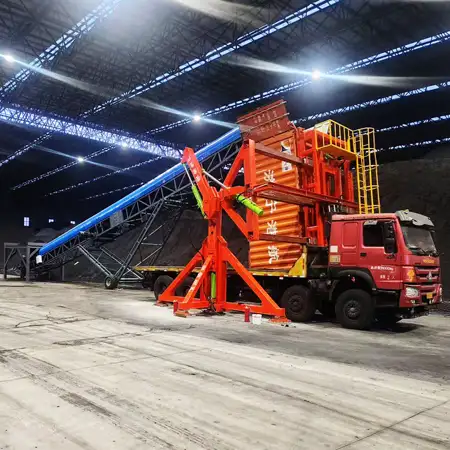
For truck loading applications, a self-feeding truck loading mobile conveyor can provide a more direct solution. Instead of relying entirely on a separate loader to continuously feed a truck, the mobile conveyor can collect bulk material from the ground or stockpile and convey it directly into the truck. This can simplify the loading process while reducing dependence on additional mobile equipment.
2. Difficulties in Container Loading and Unloading
Containers provide an efficient way to transport bulk materials over long distances, but their enclosed structure creates unique handling challenges.
Horizontal loading of bulk materials can make it difficult to achieve a high fill level, particularly when the material must be pushed deep into the container. Operators may need telescopic conveyors, loaders, or other equipment to distribute the material throughout the container.
Unloading presents another challenge. When bulk material is packed inside a standard container, accessing the material and removing it efficiently can require significant labor and equipment.
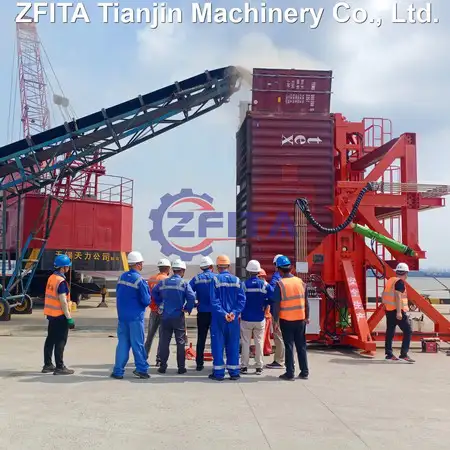
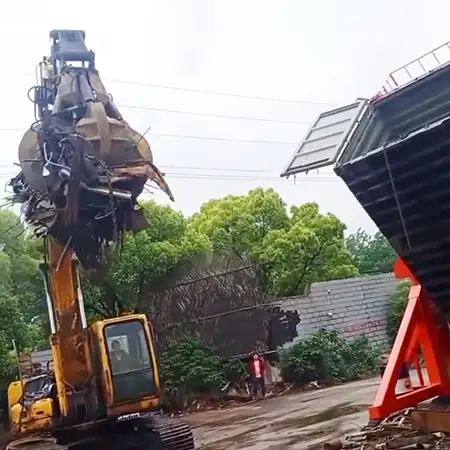
A container tilter can address this problem by changing the position of the container during loading or unloading. By placing the container at an appropriate angle, gravity can assist material flow and reduce the need for manual material removal. Depending on the application, container tilting systems can be configured for different container sizes, handling capacities, and operating conditions.
This approach is particularly useful for applications involving minerals, agricultural products, biomass, scrap, and other bulk commodities transported in containers.
3. Limited Site Space
Not every material handling operation has the luxury of a large, purpose-built facility.
Existing factories, recycling yards, warehouses, workshops, and logistics sites may have narrow access roads, limited working areas, low buildings, or restricted equipment movement. Installing a large fixed conveyor system or crane may therefore be impractical.
Equipment mobility becomes an important consideration in these environments.
Mobile conveyors, compact truck handling equipment, and mobile container handling systems can provide greater flexibility. Equipment can be moved between different loading or unloading points according to production requirements, allowing companies to improve material handling without completely redesigning their existing facility.
4. High Labor and Equipment Requirements
Bulk material handling can become labor-intensive when multiple machines and operators are required for a single material flow.
For example, a typical loading process may require a wheel loader to collect material, a truck driver to position the vehicle, another operator to control loading, and additional personnel to coordinate the operation.
Reducing the number of handling steps and machines can therefore have a significant impact on operating costs.
Modern bulk material handling equipment is increasingly designed around simplified operation and reduced labor requirements. Mobile conveyors, automated weighing systems, hydraulic dumping equipment, and container handling systems can help integrate several handling steps into a more controlled process.
The objective is not simply to automate everything, but to use the right equipment to eliminate unnecessary manual work and improve operator productivity.
5. Problems with Truck Unloading
Truck unloading is another critical part of bulk material handling. Conventional unloading may require a dump truck, wheel loader, or manual removal depending on the truck type and material.
When standard trucks are used to transport bulk materials, unloading can become slow and inefficient, especially when the receiving area has limited space or when the material needs to be discharged at a specific location.
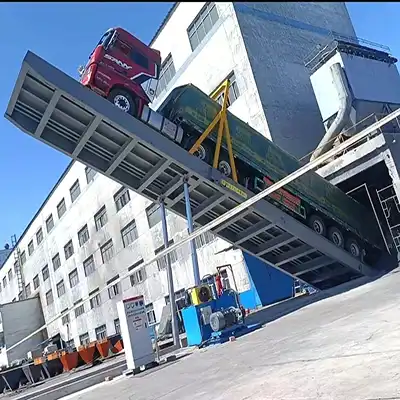
A truck dumping platform provides a dedicated solution by lifting and tipping the truck or trailer to discharge its load. Hydraulic lifting mechanisms allow the truck body to be raised to a controlled angle, allowing gravity to move the material into a receiving hopper, conveyor, pit, or storage area.
Truck dumping platforms can be particularly useful for high-volume applications where fast and repeatable unloading is more important than relying on conventional truck tipping arrangements.
6. Inaccurate or Inconvenient Material Weighing
Accurate weighing is essential for many bulk material handling operations. It affects inventory management, transportation costs, customer billing, production records, and regulatory compliance.
However, weighing is sometimes treated as a separate process rather than being integrated into the material flow. Trucks may need to travel to a dedicated weighing station before or after loading, creating additional movement and waiting time.
Truck scales, commonly known as truck weighbridges, provide a reliable way to measure the gross and tare weight of vehicles and calculate the actual quantity of material being transported.
For facilities handling large volumes of bulk materials, integrating truck weighing into the overall material handling workflow can improve both operational visibility and load management.
7. Dust, Spillage, and Material Loss
Bulk materials can generate dust and spillage during loading, unloading, conveying, and transfer. This is not only an environmental and housekeeping concern but can also affect worker safety, equipment maintenance, and material recovery.
Open transfer points, excessive drop heights, uncontrolled dumping, and repeated material handling can all contribute to dust generation and spillage.
A well-designed bulk material handling system should therefore minimize unnecessary transfer points and control how material moves between equipment. Proper conveyor design, controlled discharge, appropriate loading methods, and optimized container or truck positioning can all help reduce material loss and improve the working environment.
8. Integrating Different Handling Processes
One of the biggest challenges is that loading, unloading, conveying, weighing, and storage are often handled by different machines and systems.
A company may have an efficient conveyor but an inefficient truck loading process. Another facility may have a high-capacity truck scale but slow unloading operations. Improving one piece of equipment does not necessarily improve the entire material flow.
For this reason, bulk material handling should be considered as a complete process rather than a collection of individual machines.
A typical system may combine:
- Container tilters for container loading or unloading
- Self-feeding mobile conveyors for truck loading
- Truck dumping platforms for truck unloading
- Truck scales for vehicle and material weighing
- Conveyors for continuous material transfer
- Hoppers and feeders for controlled material flow
- Stockpiling equipment for storage and material distribution
The right combination depends on the material characteristics, required capacity, site conditions, available space, and desired level of automation.
Choosing the Right Bulk Material Handling Solution
There is no single piece of equipment that can solve every bulk material handling challenge. The most effective solution starts with understanding the complete material flow.
Before selecting equipment, companies should consider several key questions:
What material is being handled?
Particle size, bulk density, moisture content, flowability, abrasiveness, and material temperature can all influence equipment selection.
Where does the material come from and where does it need to go?
The equipment configuration should match the actual loading, unloading, transfer, and storage process.
What capacity is required?
Equipment should be selected according to the required tons per hour, truck turnaround time, container loading requirements, and peak operating conditions.
What are the site limitations?
Available space, access routes, ground conditions, building height, and equipment mobility can significantly affect the design.
How many operators are required?
Reducing unnecessary manual handling and coordinating multiple machines can improve productivity and reduce long-term operating costs.
Building a More Efficient Material Handling Process
The most effective bulk material handling systems focus on the entire workflow rather than one individual machine. Improving the connection between loading, unloading, conveying, weighing, and storage can create significant gains in productivity and operational efficiency.
For container-based operations, container tilters can simplify bulk container loading and unloading. For truck loading, self-feeding mobile conveyors can reduce the dependence on additional loading equipment. For truck unloading, hydraulic truck dumping platforms can provide fast and controlled discharge. Truck scales can then provide accurate weight information for transportation and inventory management.
By combining the right equipment with an appropriate process design, companies can reduce unnecessary handling steps, improve material flow, lower labor requirements, and make better use of their existing facilities.
The key is not simply to move more material—it is to move material more efficiently.
If you are evaluating a new bulk material handling system or looking to improve an existing operation, the solution should be designed around your material, capacity, site conditions, and complete workflow rather than around a single piece of equipment.